

The Met Gala
Art Exhibition or Occult Ritual?

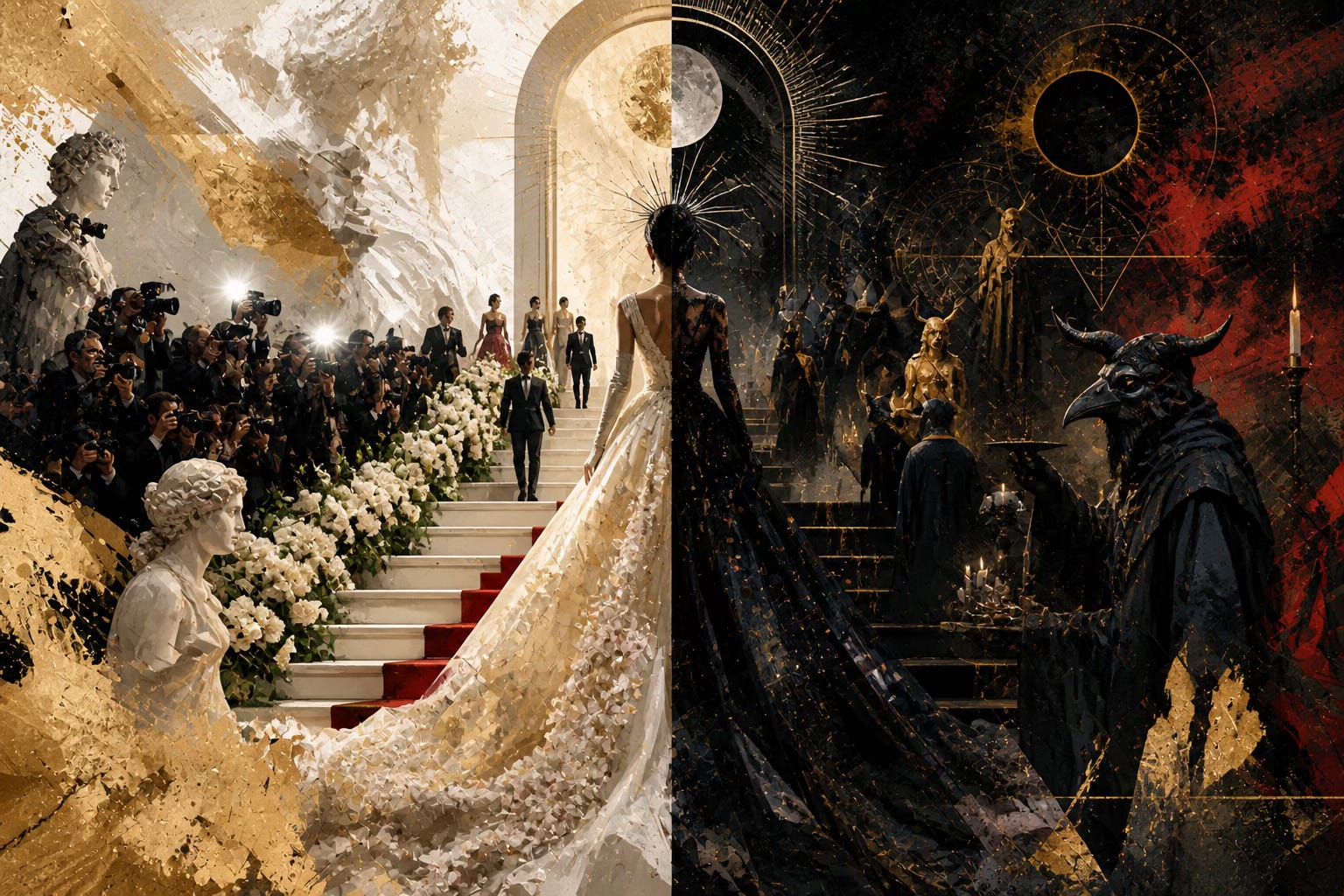
Every first Monday in May, the steps of the Metropolitan Museum of Art in New York City become the most closely watched runway on the planet. Celebrities draped in tens of thousands of dollars worth of haute couture ascend those steps under a constellation of camera flashes while the rest of America, gripped by inflation, unaffordable housing, and a health care system that bankrupts families, watches from the other side of a screen. The Met Gala is billed as a charity fundraiser for the Costume Institute, and technically that is accurate. But the technical description of what occurs on that evening has grown increasingly difficult to reconcile with the spectacle that the event has become over the past three decades—a spectacle that has provoked a remarkable and widening array of criticism, ranging from religious communities who perceive blasphemy and sacrilege in its themed celebrations, to labor organizers who see nothing but a monument to billionaire excess, to a genuinely significant segment of the digital public who have concluded, with varying degrees of seriousness and conspiracy-theory fervor, that the entire affair resembles something closer to an occult ritual than a fashion fundraiser.
To understand why the Met Gala generates such charged reactions—why it draws accusations that span the political and theological spectrum simultaneously—requires moving past the surface spectacle and examining what the event actually represents structurally: who owns it, who controls it, who attends it, what themes it chooses, what those themes communicate, and who is explicitly excluded from the conversation. When you do that, a picture emerges not of a simple charity event, but of an institution that functions as a ritual of concentrated power, a consecration ceremony for a self-selected elite that has learned to dress its exclusions and hierarchies in the language of art, culture, and philanthropy. Whether that description constitutes a “demonic ritual” in the literal, supernatural sense depends on your theological commitments. Whether it constitutes a ritual of power in the institutional and cultural sense is considerably less debatable.
Origins and the Architecture of Exclusivity
The Costume Institute Benefit, which eventually came to be known universally as the Met Gala, began in 1948 as a midnight supper organized by fashion publicist Eleanor Lambert. Its original purpose was modest and practical: to raise money for the Costume Institute’s operations at the Metropolitan Museum of Art, one of the great cultural institutions of the Western world. For the first several decades of its existence, the event occupied a dignified but relatively low-profile corner of New York’s charitable social calendar. It was a gathering of fashion industry insiders, wealthy patrons, and arts supporters—exclusive, certainly, but not yet the global phenomenon that would eventually command the attention of hundreds of millions of people worldwide.
The transformation began in earnest when Diana Vreeland, the legendary fashion editor, began serving as a special consultant to the Costume Institute in 1972. It was during the Vreeland era that the Gala was first formally held at the Met and that annual themes were introduced, giving the event its now-signature conceptual structure. But the decisive shift—the moment that converted the Met Gala from an influential industry event into the singular cultural juggernaut it has since become—arrived with Anna Wintour’s assumption of chairmanship in 1995. Wintour, then the editor-in-chief of Vogue and a figure whose name had become synonymous with fashion authority, brought to the event something that Vreeland could not: a sophisticated understanding of celebrity culture, a media apparatus of extraordinary reach through Condé Nast, and an almost surgical instinct for the leverage points of cultural power.
Under Wintour’s stewardship, the Met Gala was remade from the ground up. The guest list, which she controlled with what her colleagues described as iron discipline, shifted decisively toward Hollywood celebrities, pop stars, and eventually global cultural icons—a transformation designed to maximize media impact and donor appeal simultaneously. The event started to intermix figures like Elizabeth Taylor, Andy Warhol, Bianca Jagger, Diana Ross, Elton John, Liza Minnelli, Madonna, and Barbra Streisand with the city’s established elite. The effect was the creation of an entirely new kind of event—one that combined the social signaling function of traditional elite charity philanthropy with the mass-media reach of celebrity culture, producing a hybrid spectacle that served both institutional and individual power interests in ways that purely charity-based or purely celebrity-based events could not achieve alone.
The financial architecture of this transformation is significant and often underappreciated. In 2013, the event raised $9 million. By 2022, that figure had climbed to a record $17.4 million. By 2025, the gala had shattered its own record with a staggering $31 million raised in a single evening. The cumulative contribution to the Costume Institute surpassed $200 million following the 2019 event alone. The ticket price, which stood at $30,000 per individual in 2014, climbed to $50,000 by 2023, then $75,000 in 2024, and reached $100,000 per individual in 2026, with table sales costing $350,000—and these tickets are not available for purchase by the public, or even by the simply wealthy. Guests must be personally invited by the museum and approved by Wintour’s office. The guest list is capped at approximately 650 to 700 people, making it one of the most deliberately restricted gatherings in public life anywhere in the world. The result is an event that is not merely elite but is institutionally designed to be definitionally exclusive—structured so that its exclusivity is itself the product, the signal, and the prize.
The Wintour Doctrine: Fashion as Power Infrastructure
To describe Anna Wintour as the architect of the modern Met Gala is not hyperbole; it is the consensus assessment of fashion scholars, cultural journalists, and industry insiders alike. What makes her role structurally interesting, however, is not simply that she built the event into what it is today—that much is obvious—but rather the specific nature of the power apparatus she constructed through it. Wintour understood something that most cultural event organizers miss: that an event which controls access to itself controls the social aspirations of everyone who wants to be inside. By making attendance at the Met Gala a supreme marker of cultural validation, she created a situation in which the desire to attend the event gave her office leverage over celebrities, designers, brands, executives, and eventually politicians and tech industry figures in ways that extended far beyond any individual evening’s proceedings.
Michael Grynbaum’s account of Wintour in his book examining Condé Nast’s cultural influence describes how the Met Gala became a stage for her broader project of repositioning fashion as a pillar of American institutional influence—not merely as an industry, but as a form of cultural authority comparable to film, architecture, or contemporary art. The mainstreaming of fashion as serious culture, Grynbaum observes, happened to align perfectly with the mainstreaming of Wintour herself, creating a self-reinforcing feedback loop in which fashion’s rising seriousness elevated Vogue’s prestige, which elevated Wintour’s power, which further elevated fashion’s status, and so on. Former Met Gala planner Stephanie Winston Wolkoff described Wintour as “militant” during the event, insisting that every detail be executed to exacting standards. Designer Tom Ford, reflecting on the event’s evolution, observed that the Met Gala had transformed from an occasion where “very chic people” wore “very beautiful clothes” to an exhibition opening into something that functioned more like an elaborate costume party—a distinction he made with evident discomfort.
That discomfort points to something real about the event’s structural evolution. When the Met Gala was primarily a gathering of fashion insiders and cultural patrons, it operated within recognizable conventions of elite philanthropy. The costuming element was implicit, a matter of tasteful adherence to black-tie conventions. As Wintour’s celebrity-centered reimagining took hold, however, the event’s logic shifted. The theme-driven dress code transformed guests from patrons into participants in a curated spectacle, required to perform the event’s conceptual conceit through their clothing choices. This shift from passive attendance to active performance has been, perhaps more than any other single factor, the thing that has made the Met Gala such a potent generator of controversy. When guests perform a theme—particularly themes that touch on religious imagery, political messaging, or subcultural aesthetics—they do not merely attend an event. They embody it. And in embodying it, they invite interpretation, criticism, and symbolic analysis in ways that conventional gala attendance does not.
By 2023, a software company called Launchmetrics found that the Met Gala generated nearly double the “media impact value”—the monetary value of publicity generated—for brands than the Super Bowl, at $995 million. That figure is extraordinary and demands careful consideration. It means that the Met Gala, notionally a museum fundraiser, had become one of the most powerful engines of commercial brand amplification in the United States, surpassing sports events with massive broadcast audiences in its capacity to generate value for the fashion houses, luxury brands, and technology companies associated with it. The charitable framing of the event, in this context, begins to look less like a primary purpose and more like a legitimating frame for what is, in structural terms, an elite networking and brand-amplification apparatus of extraordinary commercial power. The Costume Institute benefits. The brands benefit. Wintour’s empire benefits. The guests benefit through association. The question of who does not benefit is one worth asking.
The Religious Question: Blasphemy, Sacrilege, and the Aesthetics of Inversion
No single moment in the Met Gala’s history has generated as sustained or as theologically serious a controversy as the 2018 edition, themed “Heavenly Bodies: Fashion and the Catholic Imagination.” The exhibition, curated by Andrew Bolton, was designed to examine the influence of the Catholic Church on fashion and creativity across centuries—a genuinely intellectually serious project that drew on approximately forty ecclesiastical works from the Sistine Chapel, items that had never before been exhibited outside the Vatican, along with more than one hundred fifty ensembles of secular clothing from the twentieth century. Bolton, in explaining the exhibition’s intent, stated that it engaged with “what we call the Catholic imagination and the way it has engaged artists and designers and shaped their approach to creativity, as opposed to any kind of theology or sociology.” The exhibition ran from May to October of 2018, attracted 1,659,647 visitors—making it the most visited exhibition in the Metropolitan Museum of Art’s entire history—and received widespread critical acclaim.
The gala itself, however, was a different matter. The dress code was described to guests as “Sunday Best” with modesty recommended in deference to the exhibition’s religious connections. What appeared on the red carpet that evening tested that description’s limits considerably. Rihanna, one of the event’s co-chairs alongside human rights lawyer Amal Clooney and designer Donatella Versace, arrived in a pearl and jewel-encrusted robe, matching papal mitre and necklace, and Christian Louboutin heels designed by Maison Margiela, presenting herself in a visual register that evoked a female pope as styled through the lens of the luxury fashion industry. Lana Del Rey appeared in a Gucci gown that incorporated a heart pierced by seven daggers, drawn from Mexican Catholic iconography. Ariana Grande wore a dress bearing a print of Michelangelo’s “The Last Judgment.” Madonna, performing during the gala, chose “Like a Prayer”—the song whose music video, featuring burning crosses and stigmata, the Vatican had officially condemned in 1989—as her featured performance piece for the evening.
The response from Catholic communities was swift and organized. On June 9, 2018, nearly five hundred Catholics gathered for a formal rally of reparation in front of the Metropolitan Museum of Art on Fifth Avenue, carrying signs with messages such as “STOP BLASPHEMING THE BLESSED VIRGIN MARY,” “Lay Catholics offer reparation for the sacrilegious Met Heavenly Bodies,” and “Cardinal Dolan: Mixing sin and sanctity is a sacrilege.” John Horvat II, a spokesperson for the American Society for the Defense of Tradition, Family and Property, stated that Catholics nationwide were deeply troubled by a show that mixed sacred symbols and Catholic imagery with what he described as immodest haute couture fashion, and that the gala inaugurating the exhibition had added insult to injury through the appearance of scantily clad celebrities in religious-themed costumes. American critic Kyle Smith argued that the Catholic Church had in effect been persuaded into “abetting the mockery of its own symbols” by lending its sacred objects to the exhibition’s institutional legitimacy while the gala itself proceeded to deploy those symbols in a fashion context that emptied them of theological meaning.
The Washington Examiner’s editorial commentary captured a question that resonated well beyond conservative Catholic circles: if the theme had been “Heavenly Bodies: Fashion and the Islamic Imagination,” or “Fashion and the Jewish Imagination,” or “Fashion and the Protestant Imagination,” would the results on the red carpet have looked remotely the same? The selective appropriation of Catholic imagery for fashion spectacle, critics argued, reflected a broader cultural pattern in which Christianity—and specifically the aesthetic richness of the Catholic tradition—has become fair game for ironic or provocative fashion deployment in ways that traditions with greater cultural sensitivity protections are not. Cardinal Timothy Dolan, the Archbishop of New York, attended the gala and expressed his view that the Catholic imagination’s capacity to find God’s glory reflected in fashion made the event a celebration rather than a desecration. But the hundreds of Catholics who assembled on Fifth Avenue the following month clearly did not share his interpretation.
The charges of demonic ritual and occult symbolism that circulated widely in the aftermath of the 2018 gala originated partly from the observation that the event’s aesthetic logic resembled what scholars of religious culture call an “inversion ritual”—a ceremonial structure in which sacred symbols are deliberately reconfigured in ways that undermine or subvert their original spiritual meaning. The concept of a black mass, which in historical and theological context refers to a parodic inversion of the Catholic Mass that allegedly featured in early modern witch trial testimony and later in various forms of theatrical and philosophical anti-clericalism, was frequently invoked by commentators attempting to describe what had occurred on that red carpet. Whether the comparison is theologically sound is a matter of religious perspective. What is analytically observable is that the deliberate deployment of papal vestments, Marian imagery, the Final Judgment, and sacred music within a context defined by extreme opulence, celebrity performance, and luxury brand promotion does represent a form of symbol transformation—the movement of sacred signifiers from their original liturgical context into an entirely secular and commercial one.
The Economy of Spectacle: Who Pays, Who Profits, Who Watches
The Met Gala’s funding model is worth examining with some care, because the charitable framing that legitimizes the event’s existence obscures a financial structure that is considerably more complex than a simple museum donation. The Costume Institute at the Metropolitan Museum of Art is one of the few departments within that institution that is entirely self-funded—meaning it must raise its own operational budget rather than drawing on the museum’s general fund. The Met Gala is the Costume Institute’s primary fundraising mechanism, and the revenue it generates funds exhibitions, publications, acquisitions, and capital improvements. This is legitimate institutional philanthropy, and the Costume Institute has produced genuinely significant exhibitions of substantial scholarly and cultural value.
However, the mechanics of how the Gala raises that money complicate the charitable narrative considerably. The tickets are purchased by corporations and wealthy individuals who are, in many cases, deducting those purchases as charitable contributions. The events are sponsored by luxury fashion houses—Chanel, Louis Vuitton, Saint Laurent—and increasingly by technology giants including Apple, Instagram, and Amazon. The media impact value generated by association with the event, as measured by Launchmetrics at $995 million in 2023, vastly exceeds the sums actually donated to the Costume Institute, meaning that the brands and celebrities who participate in the event extract substantially more commercial value from their association with it than they contribute in financial terms to the institution nominally being supported. What the Met Gala has produced, functionally, is a mechanism in which a cultural institution serves as the legitimating frame for a commercial spectacle that primarily benefits luxury brands, while the institution itself captures enough of the financial overflow to sustain its operations and expand its ambitions.
Representative Alexandria Ocasio-Cortez’s appearance at the 2021 Met Gala in a white gown bearing the words “TAX THE RICH” in large red letters across the back was, in this context, a piece of institutional critique that was simultaneously sophisticated and deeply ironic. Ocasio-Cortez attended on a complimentary ticket—ordinary ticket prices that year stood at $35,000—and explained her appearance by saying that when conversations about taxing the wealthy typically occur among working and middle-class people on the Senate floor, it was time to bring all classes into the conversation by carrying that message into a wealthy space. The dress, designed by Brooklyn-based brand Brother Vellies, generated more than one hundred thousand tweets on the day of the gala alone, temporarily making it one of the most discussed moments in the event’s history.
The criticism Ocasio-Cortez received was instructive in its structure. From the right, the charge was hypocrisy: that attending a $35,000-per-ticket event while calling for wealth redistribution demonstrated fundamental inauthenticity. From portions of the left, the critique was subtler: that wearing a message of economic justice as a fashion statement within the very institution that most elegantly demonstrates the functioning of concentrated wealth reduced a serious political demand to aesthetic performance art that served the event’s media appetite without actually threatening the power structures it claimed to challenge. What neither critique adequately addressed was the more fundamental problem—that the Met Gala’s existence as an institution is itself a demonstration of how concentrated wealth maintains its cultural legitimacy through philanthropic branding, and that attending it to protest it, however sincerely motivated, necessarily participates in the reproduction of the spectacle it nominally challenges.
The Bezos Edition: When Oligarchy Takes a Bow
The 2026 Met Gala crystallized debates that had been building for years into an unusually direct confrontation between the event’s self-presentation as a cultural institution and its critics’ characterization of it as a monument to oligarchic power. Amazon founder and executive chair Jeff Bezos and his wife, Lauren Sánchez Bezos, were announced as the event’s honorary co-chairs, joining official co-chairs Beyoncé, Nicole Kidman, Venus Williams, and Anna Wintour. Bezos ranked as one of the wealthiest individuals on earth according to the Forbes real-time billionaire index, and his presence at the top of the Met Gala’s organizational structure prompted a backlash that was unusual in both its scale and its specificity.
The protest response was organized, diverse, and geographically extensive in ways that previous Met Gala controversies had not been. Activist groups including Everyone Hates Elon papered New York City with posters urging a boycott. Guerrilla advertisements placed covertly in subway advertising slots carried the message that the Bezos Met Gala was “Brought to you by worker exploitation,” referencing the documented allegations of labor violations that have surrounded Amazon’s warehouse operations—allegations concerning unsafe working conditions, injury rates, mandatory productivity quotas, and the suppression of unionization efforts. A separate poster read “The Bezos Met Gala: Brought to You by the Company that Powers ICE,” referencing Amazon’s cloud computing contracts with Immigration and Customs Enforcement under the Trump administration. An image was projected onto Bezos’s reported $120 million penthouse, organized by Carolina Amazonians United for Solidarity and Empowerment, featuring a seventy-two-year-old Amazon worker from North Carolina. An Amazon worker from the same warehouse that had recently experienced a worker fatality participated in the demonstration. New York City Mayor Zohran Mamdani, elected amid growing public anxiety over income inequality, announced he would skip the gathering, stating that his focus was on making the most expensive city in the United States affordable for ordinary residents.
In the Meatpacking District, a counter-event called “Ball Without Billionaires” drew labor activists and emerging fashion designers to an alternative runway show where Amazon warehouse workers and union organizers walked alongside fashion looks from independent designers. Actor and SAG-AFTRA vice president Lisa Ann Walter emceed the event, systematically cataloguing Amazon’s labor record and contrasting it with the spectacle occurring a short distance away at the Metropolitan Museum of Art, where individual tickets now cost $100,000 and tables sold for $350,000. The juxtaposition was stark and was clearly intended to be. The workers who generate the wealth that allows a Bezos to donate at the scale required to become honorary chair of the Met Gala were, quite literally, standing on a runway in the street while their employer ascended the museum’s carpeted steps.
Wintour, for her part, defended the Bezoses’ involvement in terms that were characteristically institutional: the museum’s director Max Hollein described the Gala as part of “the history of American philanthropy,” in which donors across the political spectrum support cultural institutions, and Wintour herself described Lauren Sánchez Bezos as “a wonderful asset to the museum and the event” and “a great lover of costume and obviously of fashion.” These defenses were not implausible on their own terms—the history of American cultural philanthropy is indeed a history of wealthy patrons whose commercial practices were often deeply contested supporting institutions of genuine public value. The Rockefellers, the Carnegies, the Mellons: the pattern is a familiar one. But critics of the 2026 edition argued that there was something qualitatively different about celebrating Bezos in the current moment of extreme inequality and in the specific context of ongoing labor conflict involving Amazon workers, a point that the “Ball Without Billionaires” organizers and Mayor Mamdani both articulated clearly.
The protest outside the 2026 Met Gala represented something larger than a single event’s controversy. It was a crystallization of a broader social confrontation with what the French sociologist Pierre Bourdieu called “cultural capital”—the process by which dominant social classes reproduce their legitimacy not merely through economic power but through their capacity to define, control, and consecrate cultural authority. The Met Gala, in this analytical frame, is not incidentally connected to concentrated wealth; it is constitutively dependent upon it. The event exists to transform economic capital into cultural capital through a ceremonial process of institutional consecration. The billionaire who donates to become a chair is not merely giving money to a museum—they are purchasing symbolic membership in a cultural aristocracy whose authority extends far beyond their net worth.
The Ritual Structure of Power
The language of “ritual” that appears with such frequency in criticism of the Met Gala—whether from religious conservatives who perceive blasphemy, from labor organizers who see oligarchic spectacle, or from conspiracy theorists who allege literal occult practice—deserves analytical attention that takes its structural logic seriously even when its most extreme manifestations do not warrant credulity. The word “ritual” in social science refers not primarily to religious ceremony but to any formalized, repetitive, symbolically dense social performance that serves to establish, reinforce, or legitimize social hierarchies and communal identities. By that definition, the Met Gala is unambiguously and profoundly ritualistic, and this is not a criticism but a description.
Consider the formal elements: the event occurs annually, on the same day of the calendar year, at the same location, under the same organizational authority, with the same structural elements reproduced each time—the red carpet, the themed dress code, the curated guest list, the celebrity co-chairs, the charitable framing, the exclusive dinner. Attendance is regulated by an elaborate gatekeeping system that determines not merely who may enter but how they may dress, where they may sit, and how they interact with the event’s public-facing media apparatus. The event has its own internal hierarchy—honorary chairs, official co-chairs, invited guests—each position carrying specific social meanings and responsibilities. The themes are selected and curated by a central authority with interpretive power over their meaning. Guests are required to perform the theme through their clothing, submitting their bodies as vehicles for the event’s conceptual message. The entire proceedings are documented, broadcast, and analyzed with an intensity that exceeds any equivalent social gathering in American public life.
These are, structurally, the characteristics of ritual. The question is not whether the Met Gala is ritualistic—it clearly is—but what the ritual accomplishes and in whose interest it operates. Traditional religious ritual serves to connect practitioners to transcendent meaning, to mark temporal transitions, to reinforce communal bonds, and to transmit cultural memory across generations. The Met Gala’s ritual logic serves different but analogous functions: it marks the boundaries of a cultural elite, it transmits the aesthetic and social values of that elite across time, it provides mechanisms for inducting new members through invitation, and it reinforces the legitimacy of concentrated wealth and power by associating it with genuine cultural production and philanthropy.
The allegations of demonic or occult ritual that circulate on social media after each Met Gala—and that have intensified since the 2018 “Heavenly Bodies” edition—reflect something real even if they misidentify its character. The observers who make these allegations are responding, often without the analytical vocabulary to express it precisely, to a genuine structural phenomenon: the fact that the event deploys sacred symbols, performs elaborate ceremonial choreography, involves a carefully selected and hierarchically organized group of participants, and takes place within a cultural institution that functions as a kind of secular temple. The conspiracy theory version of this observation locates the explanation in secret satanic allegiances among the world’s cultural elite. The more analytically defensible version locates the explanation in the structural logic of how power operates through culture—how institutions, rituals, and symbolic practices function to naturalize hierarchies that might otherwise appear arbitrary or unjust.
The symbols of religion and of power have always been entangled because both serve the function of establishing what is sacred and what is profane, what is inside and what is outside, who belongs and who does not. When the Met Gala borrows the vestments of the papacy and drapes them on pop stars in a context defined by extreme wealth and commercial luxury, it does not necessarily invoke Satan—but it does enact a kind of symbolic displacement in which the sacred is subordinated to the commercial, in which the garments that were made to facilitate the worship of the divine are remade as vehicles for the worship of celebrity and wealth. That transformation—whether one regards it as spiritually dangerous or merely aesthetically brazen—is real and observable, and it accounts for a significant portion of the discomfort that the event generates in people who are not primarily concerned with conspiracy theories but who retain some intuitive attachment to the idea that there are things that cannot and should not simply be purchased, curated, and consumed.
Fashion as Ideological Performance
The themed dress code that distinguishes the Met Gala from every other charity gala in American life is not merely an aesthetic feature. It is the mechanism through which the event produces its cultural power. By requiring guests to interpret and embody a theme through their clothing, the Met Gala converts fashion from a system of personal expression into a system of institutional ideology—a process by which the event’s organizers define reality and then require its participants to perform that definition on their bodies in front of hundreds of millions of observers. The themes themselves—their selection, their framing, their curatorial interpretation—are therefore not neutral aesthetic choices but statements about what the cultural authorities behind the event regard as significant, worthy of celebration, and available for transformation into fashion spectacle.
This is why the choice of themes over the years tells a remarkably coherent story about the sensibility and values of the apparatus that runs the event. The 2015 theme, “China: Through the Looking Glass,” was criticized as orientalist and as a vehicle for perpetuating Western stereotypes about Asian culture, with commentators noting that the phrase “through the looking glass”—connoting distortion and unreality—was a peculiar frame for a celebration of Chinese aesthetics. The 2019 theme, “Camp: Notes on Fashion,” drew on Susan Sontag’s influential 1964 essay to celebrate extravagance, artifice, and “love of the unnatural”—a sensibility that critics noted was particularly well suited to an event defined by its own theatrical excess. The 2021 theme, “In America: A Lexicon of Fashion,” invited celebrity attendees to define American identity through fashion at a moment of profound national division, producing interpretations that ranged from the genuinely thoughtful to the deeply confused. The 2025 theme, “Superfine: Tailoring Black Style,” explored Black dandyism and its historical relationship to dignity, resistance, and self-presentation in the face of racial exclusion—arguably the most intellectually substantive theme in recent memory.
What these themes share is the structural feature that they all take something historically or culturally significant and run it through the Met Gala’s processing mechanism—the apparatus of luxury fashion, celebrity performance, and extreme wealth display—to produce a version of that thing that is aestheticized, commercially valuable, and accessible to the audience of hundreds of millions who watch from outside. Whether this process enriches the thing being celebrated or strips it of meaning is a question that does not have a single answer. When the “Superfine” exhibition gave cultural recognition to Black dandyism’s historical significance as a form of resistance to racist exclusion, something genuine was being acknowledged and amplified. When the “Heavenly Bodies” exhibition reduced the liturgical vestments of the Catholic tradition to fashion inspiration for celebrities performing wealth in front of luxury brands, something rather different was occurring.
The consistency of the event’s underlying logic across all these variations is the most important thing to observe. Regardless of theme—whether Catholic imagination or Chinese aesthetics or American identity or Black style—the Met Gala always performs the same fundamental ceremony: it takes the thing being celebrated, passes it through the filter of extreme luxury and celebrity, and produces a version that serves the interests of the event’s commercial and institutional apparatus. The culture being celebrated is always, at some level, the culture being consumed. This is not unique to the Met Gala—it is a feature of how powerful cultural institutions operate generally—but the Met Gala performs this function with a theatrical clarity and on a scale of excess that makes the underlying dynamics unusually visible.
The Digital Spectacle and the Mass Audience
One of the most consequential and underexamined dimensions of the Met Gala’s contemporary power is the relationship between the event itself—which approximately 650 to 700 people actually attend—and the audience of many tens of millions who watch it through digital media. This relationship is not incidental to the event’s design; it is central to it. The Met Gala’s commercial value, as measured by Launchmetrics’ $995 million media impact figure, derives almost entirely from the digital audience’s engagement with the event. The luxury brands that sponsor and attend the gala are not primarily investing in the experience of the 650 people inside the museum; they are investing in the attention of the hundreds of millions of people outside it who will spend the following days consuming, discussing, analyzing, and reproducing images of the gala’s red carpet.
This structure creates a dynamic that is worth examining carefully: a radically exclusive event generates its power precisely through the mass attention of people who are radically excluded from it. The Met Gala could not sustain its cultural authority if it were not watched. The watching—the consumption of its imagery, the analysis of its looks, the debate about its themes, the social media engagement that generates its media impact value—is performed almost entirely by people who could not possibly afford to attend. A $100,000 ticket represents roughly four years of full-time work at the federal minimum wage. The people who generate the event’s commercial value through their attention are, in economic terms, the people most categorically excluded from participating in it as anything other than an audience.
This is a remarkable inversion of the relationship between labor and value. In conventional economic terms, value is generated by those who produce it. In the attention economy of the digital media landscape, value is generated by those who watch. The Met Gala has constructed a mechanism in which the concentrated wealth of 650 people is amplified into commercial power by the attention of tens of millions of people whose own economic circumstances are almost certainly precarious relative to those whose activities they are consuming. The charity framing—the reminder that the event raises money for the Costume Institute—functions in this context as a moral legitimation that obscures the fundamental commercial dynamic at work.
Starting in the 2020s, the Met Gala began explicitly incorporating social media influencers into its guest list, acknowledging the structural dependency of the event on digital audience engagement. This move was candid in its logic: by bringing inside the museum people whose function was specifically to translate the event’s exclusivity into social media content for mass audiences, the organizers formalized the relationship between the event’s interior world of concentrated privilege and the exterior world of mass consumption that sustains its cultural power. TikTok served as a sponsor for the 2024 event even as it had been designated a national security threat by the United States government—a combination of commercial entanglements that crystallized the event’s indifference to political coherence in favor of cultural capital maximization.
What the Conspiracy Reveals About the Reality
The persistence and popular reach of the theories that characterize the Met Gala as a literally demonic or occult ritual—theories that circulate across TikTok, YouTube, and various political social media ecosystems—deserve to be taken seriously not as empirically credible claims about secret satanic ceremonies, but as socially significant symptoms of something real. Conspiracy theories, as scholars of political psychology have long observed, tend to flourish in conditions of genuine structural opacity—situations where large and consequential decisions are made by a small and unaccountable elite whose actual deliberations are invisible to those affected by them, and where the explanations offered by official sources fail to adequately account for the experiences and anxieties of the people being governed.
The Met Gala is not a secret organization. Its organizational structure is public. Its charity status is documented. Its guest list is photographed and published. Anna Wintour does not hide her role in controlling it. Jeff Bezos did not conceal his involvement as honorary chair. The event is, in formal terms, one of the most publicly visible gatherings of elite cultural power in the world. And yet, despite this formal visibility, it generates substantial public feelings of opacity, exclusion, and powerlessness—feelings that the conspiracy theory discourse channels into supernatural explanations because the structural explanations are either unfamiliar or unsatisfying.
The structural explanation, which this article has attempted to provide, is that the Met Gala functions as a ritual of institutional legitimation for concentrated wealth and power—a ceremony through which economic capital is converted into cultural capital, through which the social boundaries of an elite are marked and reinforced, through which sacred symbols and cultural traditions are processed through the apparatus of luxury to serve commercial and reputational ends, and through which a mass audience is engaged as the necessary fuel for a spectacle from which they are categorically excluded. This is not a demonic ritual in the theological sense. It is a power ritual in the sociological sense, and the difference matters both because supernatural explanations are not accurate and because structural explanations are actionable in ways that supernatural ones are not.
When observers on TikTok note that the 2018 Met Gala’s aesthetic appeared to invert and mock Catholic sacred imagery, they are describing something real. When they extend that observation into a theory of organized satanic conspiracy, they are adding a layer of explanation that is not supported by evidence and that tends to deflect attention from the structural dynamics that would actually explain what they observed. The luxury fashion industry’s relationship to religious symbolism is not explained by secret occult allegiance; it is explained by the fashion industry’s systematic practice of appropriating aesthetically powerful cultural material for commercial deployment, regardless of that material’s original sacred context. This practice is arguably more troubling than the conspiracy theory version, because it is a feature of how markets operate and not an aberration caused by secret bad actors who could, in theory, be identified and removed.
The Protest and Its Limits
The growing protest culture surrounding the Met Gala—most recently manifested in the labor activist demonstrations outside the 2026 Bezos edition—represents a genuine and important form of political engagement with the event’s underlying power dynamics. The organizers of the “Ball Without Billionaires,” the labor unions who rallied Amazon workers in the Meatpacking District, the activist groups who plastered New York City with boycott posters, and the New York City Mayor who declined his invitation were all responding to real structural problems with real organizational effort. Their analysis—that the Met Gala functions as a celebration of concentrated wealth that extracts its cultural legitimacy from the labor of workers who receive none of its benefits—is analytically sound and politically important.
The limitations of the protest are also real, however, and are worth acknowledging honestly. The 2026 Met Gala proceeded as planned. The boycott did not prevent it. Jeff Bezos ascended the steps. The event raised enormous sums. The media coverage was, if anything, amplified by the controversy surrounding Bezos’s involvement, generating additional attention and media impact value for the brands associated with the event. The protest outside a luxury event has an uncomfortable structural relationship with the luxury event it protests: in generating coverage, discussion, and attention, it participates in the reproduction of the spectacle it critiques. This is not a reason not to protest—silence is not an alternative that serves political accountability—but it is a reason to understand that protest alone, even well-organized and politically sophisticated protest, does not restructure the institutional apparatus that makes the Met Gala possible.
What would structural reform look like? It might involve changes to the tax treatment of charitable donations to cultural institutions that function primarily as commercial brand-amplification mechanisms. It might involve labor policy reforms that change the relationship between corporate power and the workers whose efforts generate the wealth that eventually ends up on a museum’s steps. It might involve democratic accountability mechanisms for cultural institutions that currently operate with substantial public subsidy but minimal public governance. None of these reforms are straightforward or politically available in the short term. But they represent the kind of structural engagement that goes beyond the symbolic gesture of the boycott and addresses the actual institutional dynamics at work.
The Temple of Late Capitalism
The Met Gala is neither a demonic ritual in the supernatural sense nor a simple charity fundraiser in the philanthropic sense. It is something more institutionally interesting and more structurally revealing than either description captures: a ceremony of concentrated power that has learned to dress itself in the language of art, culture, philanthropy, and spectacle in ways that simultaneously attract mass attention, generate commercial value, reinforce elite social hierarchies, and displace any serious examination of the economic and political conditions that make the whole apparatus possible.
The religious imagery that appears in its themed exhibitions is not chosen with satirical intent toward Christianity, but the cultural logic of the event inevitably subordinates whatever it touches—including the sacred—to the imperatives of aesthetic performance and commercial deployment. The religious communities who responded with genuine distress to the 2018 “Heavenly Bodies” gala were perceiving something real, even if the supernatural framing of demonic ritual was not the most analytically precise way to name it. What they were perceiving was the subordination of the sacred to the commercial—the transformation of liturgical vestments into fashion inspiration, of the Catholic imagination into the raw material for a luxury brand event, of the sacred image into the spectacular commodity.
The labor activists who protested the 2026 Bezos edition were equally perceiving something real: that the wealth displayed so elaborately inside the museum was generated through economic relationships characterized by significant inequality and documented labor abuses, and that celebrating its possessor with the highest cultural honors available was a form of institutional endorsement of those relationships. The two protests—from religious conservatives in 2018 and labor activists in 2026—appear ideologically distant. In structural terms, they were responding to the same underlying phenomenon: the Met Gala’s function as a consecration ceremony for power, one that borrows the forms of cultural seriousness and artistic legitimacy to normalize what is, at its foundation, an extraordinarily concentrated accumulation of social, economic, and symbolic authority.
Whether the ritual deserves the label “demonic” depends entirely on your theology. Whether it deserves sustained critical scrutiny, democratic accountability, and serious structural reform is, in the end, no question at all.
This article examines the Metropolitan Museum of Art’s Costume Institute Benefit—known globally as the Met Gala—as a site of concentrated institutional power, analyzing its historical evolution from charity fundraiser to elite consecration ceremony, the religious and cultural controversies generated by its themed exhibitions, the labor and inequality critiques intensified by billionaire sponsorship, and the social function of its ritual exclusion of mass audiences from a spectacle sustained entirely by their attention.