

While America Struggles, the Tech Oligarchy Cashes In
How Trump's Return to Power Delivered a Trillion-Dollar Windfall to Silicon Valley's Elite

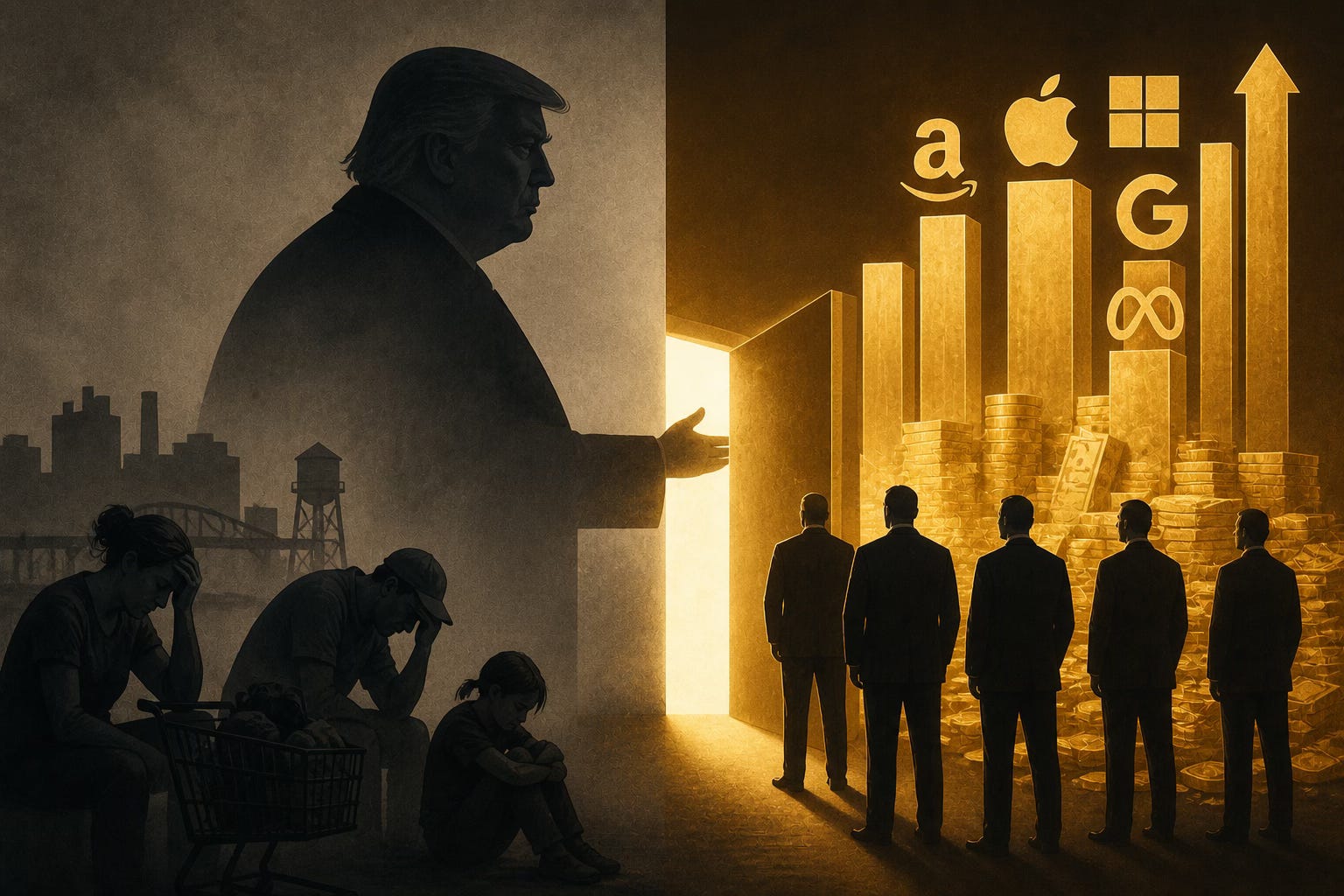
On January 20, 2025, as Donald Trump took his second oath of office in the rotunda of the United States Capitol, the most powerful men in American technology sat in places of honor just steps away from the new president. Elon Musk, Mark Zuckerberg, Jeff Bezos, Sundar Pichai, and Jensen Huang — men whose combined fortunes dwarfed the gross domestic products of entire nations — occupied front-row seats at the coronation of an administration that would, within months, shower them with regulatory relief, federal contracts, sweeping tax legislation, and a level of institutional access that the American system of democratic governance was never designed to permit. The proximity was not coincidental. It was the visible architecture of a relationship that had been built carefully, funded generously, and structured to deliver measurable returns.
Trump’s record-shattering inaugural fund collected $245 million — nearly triple what his 2017 inauguration raised and four times the sum raised by President Biden’s 2021 ceremony — with a historic concentration of big-money influence, a Brennan Center analysis found. The committee raised more money from donors giving at least $1 million than any previous inauguration had raised in total. Meta donated $1 million. Amazon donated $1 million. Elon Musk, who had spent $288 million to support Trump’s campaign, sat at the right hand of the administration’s power structure in a way no private citizen had ever done in the modern era. These were not acts of civic enthusiasm. They were investments, and the returns have been staggering.
By the close of 2025, a new Americans for Tax Fairness analysis of Forbes data revealed that American billionaire wealth had grown by 22 percent in a single year, rising from $6.7 trillion to $8.2 trillion — a $1.5 trillion increase in the fortunes of the already unimaginably rich, even as families lost access to healthcare, food assistance dried up, and the cost of groceries, housing, and everyday goods climbed higher with each passing month. The number of American billionaires itself grew, from 814 to 935, while the number of Americans who couldn’t afford food or basic medical care also expanded. The 10 richest Americans alone saw their collective fortune grow by nearly $700 billion since Trump secured his second term. In 2025, the share of total American assets owned by the wealthiest 0.1 percent reached its highest level on record: 12.6 percent. What transpired in the first year of Donald Trump’s return to the presidency was not merely a set of policy choices — it was the systematic reorganization of the American state to serve the financial interests of its wealthiest citizens while presenting itself as a populist project for working people.
Elon Musk: The Man Who Bought the Government and Moved In
No figure in American history has so brazenly merged personal financial interest with government authority as Elon Musk did in 2025. The world’s wealthiest person — whose net worth Forbes estimated at approximately $809 billion as of April 2026, a figure exceeding the annual GDP of countries like Poland and Sweden — did not merely donate to a political campaign or lobby for favorable policies from the outside. He became a de facto member of the executive branch, heading the so-called Department of Government Efficiency, known as DOGE, an entity established by executive order that immediately seized control of key federal databases, placed tens of thousands of government workers on administrative leave, and began dismantling the infrastructure of the American administrative state with breathtaking speed and virtually no democratic accountability.
The scale of the conflict of interest was without modern precedent. Musk’s companies — Tesla, SpaceX, xAI, Neuralink, The Boring Company, and X — were deeply entangled with the federal government as both contractor and regulated entity. The federal government had signed contracts worth $20 billion with SpaceX as of November 2024, making the federal treasury one of the most important customers of a company owned by the man simultaneously deciding which federal agencies to eliminate, which regulations to roll back, and which government employees to fire. In April 2025, the United States Space Force — a military branch created during Trump’s first term — awarded SpaceX nearly $6 billion in additional national security contracts covering a five-year period. The man writing the government’s budget was also one of its largest vendors.
DOGE’s approach to reform was sweeping and frequently contemptuous of legal and procedural norms. On the afternoon of Inauguration Day, a DOGE team took over the offices of the Director of the Office of Personnel Management and assumed control of key federal databases. More than two million government employees were emailed a deferred resignation offer. DOGE gained access to databases at the Treasury Department’s Bureau of the Fiscal Service, which disburses most of the government’s payments. The U.S. Agency for International Development was targeted for elimination, its website taken down, its 10,000 employees placed on administrative leave, and its programs worldwide suspended. The National Institutes of Health announced it would cut $4 billion in “indirect costs” supporting hospitals and universities that depend on federal research grants. The Institute of Education Sciences, the research arm of the Department of Education, had most of its contracts canceled. Critics argued, with considerable legal support, that DOGE had precipitated a constitutional crisis, with the executive branch refusing to spend money Congress had appropriated — a violation of the foundational separation of powers.
Musk’s wealth trajectory during this period was extraordinary in its volatility and, ultimately, in its scale. Tesla stock had surged to $488 per share in December 2024 on post-election optimism, briefly lifting Musk past $400 billion in personal wealth for the first time. But the association with DOGE quickly began extracting a commercial toll. Tesla dealerships faced vandalism and protests. European sales cratered. Surveys showed 57 percent of American adults holding a negative view of Musk personally. A consumer boycott campaign branded “Tesla Takedown” spread across social media. By mid-March 2025, when Trump staged a public show of support by displaying Teslas on the White House lawn and threatened to prosecute vandals as domestic terrorists, Tesla’s value had nonetheless bottomed out, wiping approximately $100 billion from Musk’s paper wealth. The Tesla stock lost more than half its peak value by mid-April 2025, and Musk himself acknowledged he was managing his government role and his corporate responsibilities “with great difficulty.”
But the long arc of Musk’s fortunes bent dramatically upward. When Musk stepped back from DOGE in late May 2025, sentiment shifted and Tesla shares began recovering. By the end of 2025, his wealth had surged to approximately $726 billion according to one analysis — up from around $421 billion at the start of the year. The Delaware Supreme Court’s December 2025 decision to restore his previously voided $55 billion Tesla compensation package, a pay deal now worth potentially $1 trillion over ten years if performance targets are met, dramatically accelerated his wealth accumulation. The merger of SpaceX with his artificial intelligence company xAI — an all-stock combination between Musk-controlled entities — created a private enterprise valued at $1.25 trillion by some estimates. By April 2026, Forbes placed Musk’s net worth at approximately $809 billion, a figure that would have seemed like science fiction just five years earlier, when he was worth $25 billion in March 2020.
The trajectory illuminates the architecture of the arrangement. Musk spent nearly $288 million to elect Trump. He then received access to the machinery of government itself, eliminating competitors to his private ventures, rolling back regulations that constrained his businesses, and operating at the center of a $6.8 trillion federal budget even as he publicly claimed to be cutting government waste. The wealth produced by those arrangements flowed almost entirely to him, taxed at rates that would have shocked any American schoolteacher or factory worker filing their annual return.
Mark Zuckerberg: The Pivot That Purchased Protection
In the months before Trump’s inauguration, Mark Zuckerberg’s political transformation was among the most dramatic corporate realignments in modern American history. The Meta CEO who had once donated hundreds of millions of dollars to election infrastructure, who had vocally supported immigration reform, who had employed a senior Democratic operative as his chief operating officer for years — abruptly and comprehensively reoriented himself and his company toward the Trump orbit. He dined with Trump at Mar-a-Lago in late November 2024. He donated $1 million to Trump’s inaugural fund. He replaced Meta’s fact-checking program with a “community notes” model. He added former Trump administration figures to Meta’s board of directors. He purchased a home in Washington, D.C.’s tony Woodland Normanstone neighborhood to ensure proximity to power. And he appeared at the Trump White House at least three times in the early months of the administration.
The returns on this investment were extraordinary. The most consequential was the resolution of a potentially existential legal threat. The Federal Trade Commission had been pursuing an antitrust lawsuit since 2020, brought originally under the first Trump administration, seeking to unwind Meta’s acquisitions of Instagram and WhatsApp — deals that had made Zuckerberg’s empire the world’s dominant social media platform. In November 2025, U.S. District Judge James Boasberg ruled that the FTC had failed to prove Meta’s acquisitions had illegally monopolized the social networking market, handing Zuckerberg a landmark legal victory that secured his company’s structural dominance over the digital attention economy for the foreseeable future. The administration that could have pressed the case aggressively chose not to. Critics argued that Zuckerberg’s cultivation of Trump — his visits to the White House, his donations, his political realignment — had done exactly what it was designed to do.
The tax benefits that followed were staggering. An analysis by the Institute on Taxation and Economic Policy found that Meta paid a federal corporate income tax rate of just 3.6 percent on its $79 billion in 2025 profits — paying $2.8 billion when it would have owed $16.5 billion at the statutory 21 percent rate. The company avoided $13.7 billion in federal taxes in a single year, driven by research and development tax credits expanded under the Trump-signed “One Big Beautiful Bill Act” and stock option deductions worth $4.3 billion. On the state level, Meta paid a nationwide effective state income tax rate of just 0.9 percent, compared to the average rate of roughly 6 percent nationally. Meta’s leaders said during a fall 2025 earnings call that the new tax law would generate “significant cash tax savings for the remainder of the current year and future years.” Meta also moved to invest at least $600 billion in American infrastructure through 2028 — a pledge Zuckerberg made at a White House dinner with tech leaders — which itself will generate further tax benefits and government goodwill.
Zuckerberg’s personal wealth grew accordingly. As of August 2025, Forbes ranked him the world’s third-richest person, with a net worth of approximately $270 billion. Meta’s stock surged more than 150 percent over the two years leading into 2025, lifting Zuckerberg’s net worth by over $100 billion. By the close of 2025, the alignment between Meta’s bottom line and the Trump administration’s policy decisions was difficult to describe as anything other than the textbook definition of regulatory capture — a corporation so thoroughly embedded in the political structure of the administration that it faced no serious legal risk, no meaningful antitrust consequence, and no effective tax burden proportionate to its profits.
The human cost of Meta’s tax avoidance was not abstract. The $13.7 billion Meta avoided paying in federal taxes in 2025 alone was enough to fund enormous portions of the Medicaid and SNAP programs that were simultaneously being gutted to pay for the very tax law that enabled Meta’s avoidance. The resources that might have kept families in healthcare and children in food assistance were, through the mechanics of tax policy, redirected upward into the balance sheet of one of the wealthiest corporations in human history.
Jeff Bezos: The Quiet Beneficiary and the Captured Press
Jeff Bezos occupied a more ambivalent position in the Trump ecosystem than Musk or Zuckerberg, but no less consequential a one. Amazon donated $1 million to Trump’s inaugural fund. Bezos attended the inauguration with his fiancée Lauren Sánchez. And the Amazon founder, who had previously been mocked by Trump as “Jeff Bozo” and whose Washington Post had been among the administration’s fiercest critics, appeared to quietly rein in the newsroom in the period following the inauguration — a decision that drew furious internal condemnation, prompted at least one Pulitzer Prize-winning journalist to resign publicly and criticize Bezos by name, and raised grave questions about the independence of one of the country’s most important news organizations.
The material returns were concrete. In April 2025, Blue Origin — Bezos’s space company — received a $2.3 billion contract from the United States Space Force for military satellite launches, the same military branch that simultaneously awarded SpaceX nearly $6 billion. The dual awards were explicitly framed as competitions, but the optics were unmistakable: both major space companies awarded massive federal contracts in the same contracting cycle, both owned by men who had donated to Trump’s inaugural fund, attended his inauguration, and maintained cordial relationships with the administration. Bloomberg reporting from May 2025 noted Bezos needed to continue winning government business to maintain Blue Origin’s momentum, a dynamic that created structural incentives to remain in favorable standing with the administration that controlled those contracts.
Amazon’s business interests, meanwhile, benefited significantly from the broader regulatory environment. Amazon had cut its tax bill by $6.5 billion in a single year through bonus depreciation provisions expanded under the Trump tax legislation, according to Americans for Tax Fairness analysis. The tax law that simultaneously slashed food assistance for 40 million Americans delivered a tax savings to Amazon that would have been sufficient to fund those food programs for multiple months. The arrangement between government and technology capital was not merely one of mutual benefit — it was one of explicit transfer, in which public resources were redirected away from the population’s basic needs and toward the accumulation of private wealth.
Bezos’s personal net worth ended 2025 at approximately $242 billion, up from $233.5 billion a year earlier. The gains were modest compared to his peers, in part because Amazon’s business model was more complex and its exposure to tariff disruption more pronounced. But the structural advantages he received — favorable regulatory treatment, federal contracts for Blue Origin, massive corporate tax savings, and the implicit protection offered by operating in alignment with an administration capable of directing regulatory and legal attention — were not trivial. They were the returns on a calculated decision to be at the table rather than on the menu.
Peter Thiel, Palantir, and the Surveillance State for Profit
If Musk, Zuckerberg, and Bezos represent the most visible faces of the tech-Trump alliance, Peter Thiel represents its most structurally alarming dimension. Thiel, one of Trump’s earliest and most consequential Silicon Valley backers, co-founded Palantir Technologies in 2003 using initial CIA venture capital funding. In Trump’s second term, Palantir has emerged as what Wired reporter Makena Kelly described as “an operating system for the entire government” — a data-mining company whose artificial intelligence platforms are now embedded across the federal government’s most sensitive institutional functions, generating extraordinary profit while enabling new and troubling forms of state surveillance and enforcement power.
The financial trajectory is breathtaking. Since Trump’s election, Palantir’s stock has surged more than 200 percent. The company’s market valuation has climbed from $50 billion at the beginning of the Trump campaign to approaching $400 billion — worth more than Verizon or Disney and nearly as much as Bank of America. Palantir received more than $900 million in federal contracts since Trump took office, according to public records obtained by the New York Times. In November 2024, the company secured a nearly $1 billion software contract with the Navy. In April 2025, ICE paid Palantir $30 million for a platform called ImmigrationOS, designed to provide “near real-time visibility” into the movements of migrants in the United States — tracking individuals through data pulled from passport records, Social Security files, IRS tax data, and license-plate reader systems. In July 2025, the Army awarded Palantir a 10-year, $10 billion Enterprise Service Agreement consolidating 75 existing contracts into a single massive deal, giving the company access to every Army database and operational system.
The conflict of interest embedded in these arrangements is as explicit as it is extraordinary. Stephen Miller, the Trump administration’s chief architect of immigration policy — the man who designed and championed the enforcement agenda for which Palantir’s ImmigrationOS was built — holds a substantial financial stake in Palantir, as documented by the American Immigration Council. The government official most responsible for generating the demand for Palantir’s immigration enforcement tools has a direct financial interest in the company providing those tools. This is not a subtle or disputed conflict. It is an open arrangement that would have generated a federal ethics investigation in any previous administration.
The White House also contracted Palantir to assist in building what government officials and company employees described to the New York Times as a “master database” — a centralized repository compiling personal information on Americans across federal agencies, cross-referencing sensitive data from tax records, immigration documents, Social Security files, and beyond. Palantir’s data analytics platform, Foundry, had already been deployed at the Department of Homeland Security and the Department of Health and Human Services, enabling cross-agency information sharing of a scope never previously authorized or implemented. Cody Venzke, senior policy counsel at the American Civil Liberties Union, told Newsweek that “shady, centralized dossiers on citizens are foundational for attacking civil rights and civil liberties,” and that AI platforms like Palantir’s represented a qualitatively new and dangerous form of government surveillance infrastructure.
Thirteen former Palantir employees — software engineers, managers, and a privacy and civil liberties specialist — published an open letter in May 2025 condemning the company’s work with the Trump administration. They warned that “democracy faces escalating threats: biometric data collection on immigrant children, journalists being targeted, science programs defunded, and key U.S. allies sidelined.” They condemned what they described as Big Tech’s “increasing complicity, normalizing authoritarianism under the guise of a ‘revolution’ led by oligarchs.” Prominent Silicon Valley investor Paul Graham called Palantir out for “building the infrastructure of the police state.” The criticism arrived from across the political spectrum — even prominent Trump supporters expressed discomfort at the idea of a centralized government database containing personal information on American citizens.
Thiel’s precise financial gains from Palantir’s government bonanza in 2025 and into 2026 are not fully public, as his stake in the private portions of the arrangement are partially obscured. But with a company whose stock has appreciated more than 200 percent since Trump’s election and whose government contract portfolio is now measured in the tens of billions of dollars, the wealth generated for Palantir’s founders and major investors by the Trump administration’s embrace of their surveillance infrastructure is measured in many billions of dollars. And the political logic that produced those gains — a Thiel-backed president deploying a Thiel-co-founded company to build the enforcement infrastructure of an aggressive immigration agenda designed by an official who owns stock in that company — is a self-contained system of institutionalized corruption that requires no conspiracy to explain. Its mechanics are perfectly legible.
Jensen Huang and the Chip Deregulation Bonanza
Nvidia CEO Jensen Huang occupied a different position in the Trump tech ecosystem than his peers — he was less publicly political, more diplomatically careful, and more explicitly focused on a single policy objective. But the lobbying access he received and the policy reversals he obtained demonstrate as clearly as any other case how the relationship between concentrated tech wealth and the Trump administration functioned.
Huang made private visits to the Trump White House and held closed-door meetings with Republican senators on the Senate Banking Committee, as reported by Fortune in December 2025. His stated objective was to secure favorable federal policy on Nvidia’s most lucrative commercial interest: the sale of artificial intelligence chips. The Biden administration had implemented what it called the “AI diffusion rule” — a set of export controls designed to limit the ability of American chip companies to sell advanced AI processors to China and other adversary nations, on the grounds that those chips could be used to develop Chinese military AI capabilities. Huang opposed the restrictions, characterizing them publicly as “a failure” based on “fundamentally flawed” assumptions, and arguing that America’s global AI leadership was best secured by ensuring that the world’s AI infrastructure — including China’s — ran on American chips.
Following a Mar-a-Lago dinner between Huang and Trump, the White House reversed course on plans to impose additional restrictions on the H20 chip — the most cutting-edge AI processor that U.S. companies could legally sell to China. Two sources with knowledge of the plan told NPR that until the dinner, the assumption had been that the H20 would soon be subject to tight new export controls. After the dinner, the administration put those restrictions on hold. In May 2025, Trump subsequently announced plans to rescind portions of the broader AI diffusion rule, a move Huang praised as a “great reversal” that he said demonstrated the administration’s correct understanding of the competitive dynamics of the global AI race.
The commercial stakes were enormous. China represents a critical market for Nvidia, and the H20 chip’s continued exportability meant billions of dollars in additional revenue. Nvidia’s shares and market position had already been enormous before the Trump administration — the company’s valuation had made it one of the most valuable in the world — but the policy access Huang purchased through proximity to Trump’s orbit translated directly into market access and commercial freedom that federal export controls had previously constrained. The argument that chip sales to China served American strategic interests may have merit on the policy merits as a genuine analytical position. What cannot be disputed is that the same policy that Huang lobbied for in private meetings with the president and Republican senators also generated billions of dollars in additional revenue for Nvidia and Huang’s personal holdings.
The “One Big Beautiful Bill” and the Machinery of Upward Transfer
The legislative capstone of the first year of Trump’s second term was the “One Big Beautiful Bill Act,” signed into law on July 4, 2025. The legislation represented the most ambitious single act of upward wealth redistribution in American legislative history, combining permanent extensions and expansions of the 2017 Tax Cuts and Jobs Act with new provisions specifically designed to reduce the tax burdens of the wealthiest Americans, corporations, and their heirs — while simultaneously imposing the most severe cuts to social programs since the Food Stamp Act was passed in 1964.
The numbers are not ambiguous. The nonpartisan Congressional Budget Office and the Joint Committee on Taxation found that the bill cuts taxes for the richest 10 percent of Americans by more than $14,700 per year per household, and cuts taxes for the richest 1 percent by more than $50,000 per year. The Tax Policy Center found that 60 percent of the bill’s tax savings benefit the richest 20 percent of households — those earning over $217,000 annually. The Institute on Taxation and Economic Policy calculated that the top 1 percent of earners would receive $117 billion in tax cuts in 2026 alone — more than the combined annual budgets of the Departments of Education, Transportation, Justice, State, NASA, the EPA, the National Endowment for the Humanities, and the National Endowment for the Arts. Millionaire earners will see an average after-tax income increase of $75,000 in 2026, according to the Tax Policy Center.
The specific mechanisms of upward transfer are worth understanding in detail, because they reveal the precision with which the legislation was designed to benefit the already wealthy. The bill made permanent the reduced top marginal income tax rate of 37 percent — a rate applying to income above $626,350 for single filers — ensuring that the wealthiest Americans would never return to the 39.6 percent rate that had applied before 2017. It made permanent the 20 percent pass-through deduction that allows owners of partnerships, LLCs, S-corporations, and sole proprietorships to effectively reduce their top tax rate to 29.6 percent on qualifying business income — a provision that disproportionately benefits wealthy business owners, not wage workers. It expanded the estate tax exemption to $15 million per person, plus inflation, permanently reduced from the $5 million threshold that had applied before 2017, at a projected cost of $212 billion through 2034 — ensuring that the heirs of the very wealthiest Americans would inherit ever-larger fortunes with ever-smaller tax obligations.
And the bill restored and expanded bonus depreciation provisions, allowing corporations to immediately write off the full cost of capital investments in the year they are made, rather than deducting them over time. Amazon reduced its tax bill by $6.5 billion through bonus depreciation in a single year. Meta reduced its bill by $4.9 billion. Alphabet reduced its bill by $3.3 billion. The provision alone is projected to cost the federal treasury $141 billion over the next decade — enough, as policy analysts noted, to have avoided the cuts to nutrition assistance that were enacted in the same bill.
Those cuts were devastating and deliberate. Trump signed into law $863 billion in Medicaid reductions and $295 billion in SNAP reductions over the period from fiscal 2025 to 2034 — combined cuts exceeding $1 trillion for programs that serve America’s most economically vulnerable people. The Congressional Budget Office projected that the bill would cause 10.9 million Americans to lose health insurance through Medicaid alone, with an additional 5.1 million losing coverage through the expiration of enhanced marketplace premium tax credits — a combined 16 million more uninsured Americans by 2034. SNAP participation nationally fell by more than 3 million people — an 8 percent reduction — between the law’s July 2025 enactment and January 2026, with some states recording declines as high as 42 percent. The program that had served more than 41 million low-income Americans, providing an average monthly benefit of approximately $187 for food, was systematically contracted at the precise moment that tariff-driven grocery inflation was hitting the same families hardest.
The CBO combined analysis of the tax cuts and spending reductions made the distributional outcome explicit: families already struggling to make ends meet lose the most. Households in the lowest income decile — earning $24,000 per year or less — face a net loss of approximately $1,200 every year due to the bill, primarily from the cuts to Medicaid and food assistance. Meanwhile, millionaire households gain tens of thousands of dollars annually. The House Budget Committee Democrats summarized the transfer with stark arithmetic: an average household making less than $15,000 per year will see a tax increase of more than 9 percent in 2027, while people making over $1 million per year will see their taxes go down by $97,000. The legislation was, in effect, a structural mechanism for taking resources from the poorest Americans and directing them — through tax cuts, corporate deductions, and regulatory permissiveness — upward to the wealthiest.
Tariffs, the Working Class, and the Inverted Populism
The defining paradox of Trump’s economic program in 2025 was the tariff regime — a set of import taxes that the administration presented as a tool of economic nationalism and working-class protection, but that in practice functioned as a regressive consumption tax falling most heavily on the Americans least able to absorb additional costs. The Yale Budget Lab found that all 2025 tariffs together created a price level increase of 2.3 percent in the short run, equivalent to an average per-household consumer loss of $3,800. Annual losses for households at the bottom of the income distribution were $1,700 — a painful figure for families already navigating rising rents, stagnant wages, and eroding safety net support.
The sectoral impacts were particularly severe for the lowest-income Americans. Apparel prices rose 17 percent under all 2025 tariff actions — a disproportionate burden for families that depend on lower-cost clothing produced in Vietnam, Bangladesh, and China. Food prices rose 2.8 percent from all 2025 tariff actions, with fresh produce rising 4 percent — compounding grocery inflation that had already been a source of widespread financial distress. The cost of a new car rose by approximately $4,000 under tariff-driven price increases. Grocery prices grew at their fastest monthly rate since fall 2022 in December 2025, with beef up 16 percent and coffee up nearly 20 percent over the course of the year.
Research by econofact found a particularly revealing pattern within these price increases: cheaper product varieties saw the highest price increases, rising at an average of 5 percent between October 2024 and September 2025, roughly double the inflation rate for premium products. Less expensive goods have smaller margins, giving retailers less capacity to absorb tariff costs rather than passing them to consumers. Since low-income households disproportionately purchase lower-cost goods, they experienced disproportionately higher cost-of-living increases from the tariffs. As Kimberly Clausing of the Peterson Institute for International Economics put it with striking clarity: “People higher in the income distribution can weather these storms without going hungry or being evicted, but many Americans live much more economically precarious lives. One of the big ironies of this policy is that Trump’s populism was really meant to speak to those left behind, and it’s going to fundamentally make their lives much, much worse.”
The Center for American Progress’s year-in-review found that clothing costs were up 14 percent compared to pre-tariff trends, household furnishings up 8 percent, and nondurable household goods like cleaning supplies and toilet paper up 5 percent. Consumer spending had slowed to roughly half of its 2024 rate. The housing market was under strain, with homebuilder sentiment at its lowest level in more than two years as elevated mortgage rates and tariff-driven construction material costs put homeownership further beyond the reach of working families. Almost 70 percent of Americans, according to survey data, predicted that 2026 would be a year of economic difficulty. A July 2025 survey found that nearly half of likely voters said Trump’s tariffs were having a negative impact on their monthly finances, with only 16 percent reporting a positive impact.
The tariffs did not, meanwhile, impose comparable costs on the wealthiest Americans. Tariffs are consumption taxes, and the wealthy consume a smaller proportion of their income on the kinds of goods most affected by import levies. A household spending $1,700 more per year on groceries, clothing, and household goods when its annual income is $40,000 has experienced a devastating reduction in real purchasing power. A household spending an additional $3,800 when its annual income is $10 million has experienced a rounding error. The structural asymmetry of the tariff burden was not incidental to the administration’s broader distributional program — it was consistent with it.
The Federal Workers: Displaced by Design
One of the most direct and visceral consequences of the tech-Trump alliance played out in the federal workforce itself. DOGE’s campaign to slash government employment, justified in the language of waste and efficiency, resulted in the displacement of hundreds of thousands of federal workers and contractors — a workforce drawn primarily from the middle and working class — while simultaneously expanding the power and commercial opportunity of private technology companies positioned to replace government functions with contracted services.
The approach was methodical in its early phases. More than two million federal employees received deferred resignation offers within days of Trump’s inauguration. Agencies across the government were subjected to sudden workforce reductions. The NIH saw $4 billion in grant funding eliminated, affecting university hospitals and research institutions across the country. USAID was effectively shuttered, cutting programs that had served vulnerable populations in dozens of countries and employing thousands of Americans in technical and humanitarian roles. The Institute of Education Sciences had most of its contracts canceled, crippling the federal government’s capacity to conduct education research that state and local school systems had depended upon for policy guidance.
The workers displaced in this process were not, in the main, the targets of DOGE’s stated efficiency crusade. Studies and reporting consistently found that many of the employees terminated or pressured to resign were experienced specialists, domain experts, and career civil servants whose knowledge and institutional memory would be costly and time-consuming to replace. What they had in common was government employment — a form of stable, middle-class work with benefits and retirement security that the private sector has increasingly failed to provide. The Commonwealth Fund estimated that combined Medicaid and SNAP cuts in the broader legislative program would result in the loss of 1.22 million jobs nationwide by 2029, equivalent to a 0.8-percentage-point increase in the unemployment rate — on top of the federal workforce reductions already underway.
The beneficiaries of this displacement were, systematically, technology companies. DOGE itself was staffed substantially by former or current employees of Musk’s companies — engineers and executives from Tesla and SpaceX who now occupied positions inside the federal government making decisions that affected the regulatory environment and contracting landscape for their former employers. The consolidation of government data into centralized platforms managed by Palantir, Amazon Web Services, and Google filled the institutional space left by the dismantled federal civil service with private contractors billing the government at commercial rates. The efficiency framing obscured the transfer: public-sector employment, with its union protections, civil service rules, and democratic accountability, was being replaced by private-sector contracting to companies owned by the same billionaires whose tax burden was simultaneously being reduced.
The Structural Logic: What This System Actually Is
It is important to name clearly what the arrangement described in this article actually represents, because the language of normal politics can obscure its character. This is not a story about a president who favored business. It is not a story about policy disagreements or competing economic theories. It is a story about the systematic capture of the American state by a concentrated group of private interests — specifically, the owners of the world’s largest technology platforms and defense-adjacent data companies — who invested in a political candidate, obtained access to the machinery of government, and used that access to redirect public resources toward their own enrichment while dismantling the institutional protections that serve the broader population.
The mechanisms are now fully documented. Musk spent $288 million to elect Trump and received a seat inside the executive branch, federal contracts worth billions, and regulatory environments favorable to all of his companies. Zuckerberg donated to the inaugural fund, visited the White House repeatedly, and received relief from an antitrust suit that would have broken up his empire, plus tax savings of $13.7 billion in a single year. Bezos donated to the inaugural fund and received federal space contracts worth $2.3 billion for Blue Origin and $6.5 billion in corporate tax savings for Amazon through bonus depreciation. Thiel’s Palantir, connected to the administration through the co-founder’s longstanding political ties and through Stephen Miller’s financial stake, received more than $900 million in new federal contracts and a $10 billion Army deal, while building surveillance infrastructure that generates ongoing contract revenue as long as the enforcement agenda it enables continues.
The 30 MAGA billionaire families who spent $1.4 billion to influence the 2024 election saw their collective wealth grow by 37.5 percent — $408 billion — in 2025 alone. The investment returned approximately 29 dollars for every dollar spent, with the returns measured not merely in financial terms but in regulatory architecture, contract revenue, tax policy, antitrust forbearance, and the structural conditions that will continue generating those returns for years.
Against this backdrop, the decision to cut $1.2 trillion from Medicaid and SNAP — programs serving the poorest Americans, the disabled, children, the elderly, working families in rural communities, veterans — appears not as an unfortunate fiscal necessity but as a functional feature of the system. The resources stripped from those programs were not eliminated from the economy. They were redirected. They became the source from which the tax cuts flowed — the revenue gap that the reductions in corporate taxes and upper-bracket income taxes created was papered over with debt and with cuts to the people least capable of absorbing them. The 14 wealthiest billionaires at the beginning of 2026, according to analysis by Americans for Tax Fairness, are worth more than every American billionaire combined from as recently as 2020. At the same time, SNAP participation fell by 3 million people, and 16 million Americans are projected to lose health insurance by 2034.
Ordinary Americans: The Weight of the Transfer
While the numbers documenting the enrichment of America’s tech elite are abstract in their scale, the consequences for ordinary Americans are concrete, daily, and deeply human. A teacher in Texas named Melinda — who, like many colleagues, had been buying groceries from her own pocket for students who came to school hungry — watched her weekly food costs rise to $56, meaning she would spend $400 more over the course of a single school year just to feed children whose families could not afford school supplies in an era of tariff-driven price increases. A laid-off tech worker in Austin named Alexander cut his food spending to the bare minimum, moved to cheaper housing, and took on multiple part-time jobs to survive in a city where, he said, prices were “surging within a few months without any notice.” A 31-year-old in the same city worked up to six side gigs simultaneously — selling clothes online, working as a theater stagehand, cutting craft ice for cocktail bars — to keep up with rent.
These are not aberrations. They are the baseline reality for tens of millions of Americans in the economy that the tech-Trump alliance has produced. More than 40 percent of the American population was considered poor or low-income before the full effects of the “One Big Beautiful Bill’s” SNAP and Medicaid cuts had been felt. The CBO projects that the legislation will lower SNAP enrollment by an average of 4.7 million people, with those remaining in the program seeing their nutrition allotments reduced. Households in the lowest income decile — those earning $24,000 a year or less — will experience a net loss of approximately $1,200 annually from the combined effects of spending cuts and tax changes.
Healthcare, already the most acute source of financial anxiety for working-class Americans, grew more precarious. With 10.9 million people projected to lose Medicaid coverage, hospitals in rural and lower-income communities — which depend heavily on Medicaid reimbursement — face potential closures and service cuts. The Commonwealth Fund found that the legislation’s Medicaid cuts, combined with the tariff-driven economic disruption and SNAP reductions, would collectively cost states $12 billion in tax revenues and produce 1.22 million job losses by 2029. States with higher rates of poverty would be harmed more severely, in a pattern characteristic of all the major policy changes of the Trump second term: the most economically vulnerable places and people absorb the largest costs.
The housing market offered no relief. Tariff-driven increases in construction material costs combined with elevated mortgage rates kept homeownership out of reach for families that had hoped to build wealth through real estate — the primary mechanism through which working- and middle-class Americans have historically accumulated assets. Electricity prices increased 2.5 times faster than the general inflation rate in 2025, the highest annual increase since 2014. Natural gas wholesale spot prices rose 56 percent from 2024 averages. Utility bills across 49 states were expected to rise by a cumulative $92 billion by 2028. The administration that had promised on Day One to lower prices for struggling Americans had, by the end of its first year, overseen a comprehensive deterioration of living standards for the bottom half of the income distribution.
Democracy in the Shadow of the Oligarchy
The concentration of wealth, political power, and government access now visible in the relationship between the Trump administration and America’s tech elite represents something more consequential than policy disagreement or even ordinary corruption. It represents a structural transformation in the character of American democracy itself — a condition in which the formal mechanisms of democratic governance continue to operate, elections are held, legislation is passed, court decisions are rendered, while the substantive content of public policy is determined by the preferences and financial interests of a small group of extraordinarily wealthy private actors who have purchased the access required to shape those outcomes.
The Washington Monthly observed in April 2025 that each of the billionaire owners of major social media platforms — companies that shape the information environment in which democratic deliberation takes place — is dependent on federal government contracts and regulations, creating structural incentives for favorable coverage and political alignment that other countries have recognized and prosecuted as corruption. When the government contractor is also the press magnate, and the press magnate’s coverage shapes the political environment in which regulatory decisions about the contractor are made, the loop of mutual benefit becomes a circuit of institutional capture whose effects are difficult to distinguish from the textbook definition of democratic decay.
The ACLU warned that Palantir’s master database project — centralizing personal information on American citizens across government agencies, cross-referencing financial records, immigration status, tax data, and biometric information in a single AI-powered platform — represented “a foundational infrastructure for attacking civil rights and civil liberties.” Former Palantir employees who left the company because of its Trump administration work warned that “democracy faces escalating threats” and that big tech was “normalizing authoritarianism under the guise of a ‘revolution’ led by oligarchs.” These are not hyperbolic charges from marginal critics. They are assessments by people with direct knowledge of the systems being built, about the uses to which those systems are being put.
The wealth figures, examined in this light, are not merely data points about market performance. They are measures of how thoroughly the redistribution has already proceeded. The 14 wealthiest American billionaires are today worth more than all American billionaires combined were worth just five years ago. The collective wealth of all U.S. billionaires stands at $8.2 trillion — a number that exceeds the annual GDP of every country on Earth except China and the United States itself. In 2025, the share of total American assets owned by the wealthiest 0.1 percent reached its highest recorded level. Meanwhile, SNAP participation fell by 3 million people, Medicaid coverage is being stripped from the sick and the poor, grocery prices are at historic highs, and an increasingly large share of the American working class lives in conditions of economic precarity that the billionaires in the Capitol Rotunda on January 20, 2025 will never experience, cannot meaningfully comprehend, and have actively used their political influence to deepen.
This is not a story with a villain’s monologue. The tech elites who have benefited most from Trump’s return to office are not, for the most part, motivated by malice toward ordinary Americans. They are motivated by the logic of capital accumulation and the maximization of financial return. The system that has concentrated this much wealth in this few hands, and then provided those hands with the levers of government, is producing entirely predictable outcomes. Profit flows to those who control the process. Costs are externalized to those who cannot. The public treasury, built from the labor and consumption of hundreds of millions of Americans, is being systematically redirected toward the enrichment of a few thousand.
The question that remains — and that will define the character of American democracy in the years ahead — is whether the people who bear those costs possess the political power, the institutional tools, and the will to reverse the process before the distance between the billionaire class and everyone else becomes so great, and the capture of democratic institutions so complete, that the reversal is no longer structurally possible.
This article documents the concentration of political access, financial benefit, and government-directed wealth accumulation by America’s technology elite during the first year of Donald Trump’s second presidential term, examining how the policy architecture of the Trump administration — including tax legislation, regulatory relief, federal contracting, and the dismantling of social safety net programs — has produced historic gains for the country’s wealthiest citizens while imposing escalating costs on the working class, the poor, the elderly, and the medically vulnerable.